

Checking the count: How official statistics are missing the warehouse revolution
The US warehousing sector has undergone a profound transformation, evolving from traditional storage sites into high‑throughput logistics hubs that handle picking, packing, and goods movement at unprecedented scale. Employment has nearly tripled, mega‑facilities now anchor the industry’s footprint, and the mix of occupations has shifted toward item‑level fulfillment work, automation‑supported workflows, and increasingly technical roles.
Yet official statistics have not kept pace with this shift. By examining employment, occupational change, investment, and output across multiple data sources, this report shows how current measurement frameworks obscure the true scale, complexity, and economic value of modern fulfillment and distribution operations—and why better data are needed to capture the sector’s strategic role in today’s supply chains.
Download the report for key findings:
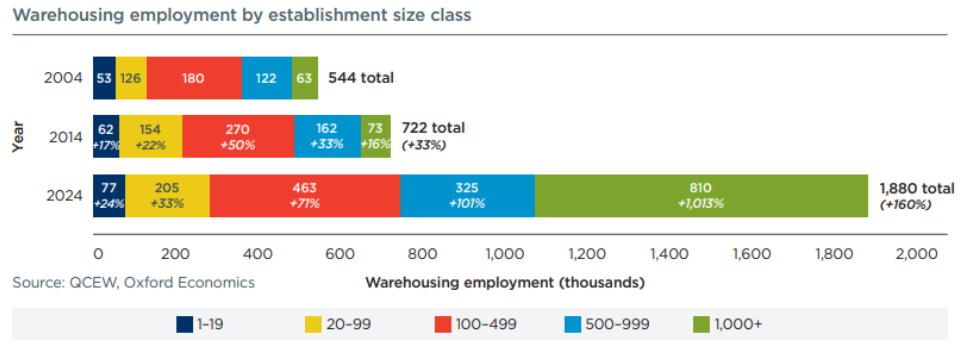
- US warehousing employment has nearly tripled from 2014 to 2024, rising from 749,000 to 1.9 million. This increase has been driven by the rapid expansion in mega‑facilities with over 1,000 workers.
- The share of material‑moving occupations also increased from 2014 to 2024, from 66% to 73%. The fastest‑growing occupations include a range of high-skill positions such as occupational health and safety specialists, software and web developers, training and development managers, and engineering and technical maintenance roles.
The experts behind the research
-
 Dan Martin
Lead Economist, Economic Impact
Dan Martin is a Lead Economist on the Economic Impact Consulting team. During his eleven years at Oxford Economics, Dan has worked on a wide range of topics, including economic footprint analyses in industries such as petroleum refining, air transportation, nuclear energy, consumer goods, and industrial trucks.
Much of his work has focused on labor markets, on topics such as overtime regulation, career progression, retirement savings, and gap analyses relating occupational demand to educational supply. He has also worked on topics such as energy efficiency, international trade, and the economics of warehousing.
Dan has a PhD in economics from Clark University, an MA from NYU, and a BS from Stanford, and previously worked at the Environmental Protection Agency.
Get in touch
Learn more about this report or how our team could support you: