

The Economic Contribution of the Cement Concrete and Aggregates Industry in Australia
Quantifying the full economic footprint of Australia’s cement, concrete and aggregates industry to inform policy, investment, and long-term infrastructure planning
Oxford Economics Australia provided the Cement Concrete & Aggregates Australia (CCAA) with a comprehensive, independent economic assessment of the industry’s national and state-level contribution. The project deliverables included rigorous input-output modelling to quantify GDP and employment impacts across direct, indirect, and induced channels; state-by-state economic analysis covering all eight jurisdictions; supply chain mapping; and a forward-looking outlook addressing construction demand, productivity, supply chain resilience, labour, and decarbonisation. Together, these deliverables gave CCAA a robust, evidence-based platform to demonstrate the industry’s full economic footprint and make a compelling case for policy reform, investment, and strategic planning at national and state levels.
Background: A foundational industry whose value was largely invisible in policy discussions
Concrete is the second most consumed substance on Earth after water – and Australia’s built environment depends on it entirely. The cement, concrete and aggregates (CCA) industry sits at the very start of Australia’s construction supply chain, supplying the materials essential to housing, transport networks, energy systems, and social infrastructure. Its annual revenues reached $16.9 billion in 2025, supported by a workforce of nearly 22,000 directly employed, with a further 7,500 truck drivers transporting CCA freight across the country.
Despite this foundational role, the CCA industry’s full economic contribution had never been comprehensively and independently quantified at the national and state level. The absence of robust data meant that its true value – and the critical risks it faces – were routinely overlooked in infrastructure planning, regulatory frameworks, and policy dialogue. Discussions about Australia’s construction capacity tended to focus on downstream pressures such as labour shortages and project sequencing, while the upstream challenges facing the CCA industry – quarry approvals, industrial land protection, freight logistics, decarbonisation costs – received far less attention.
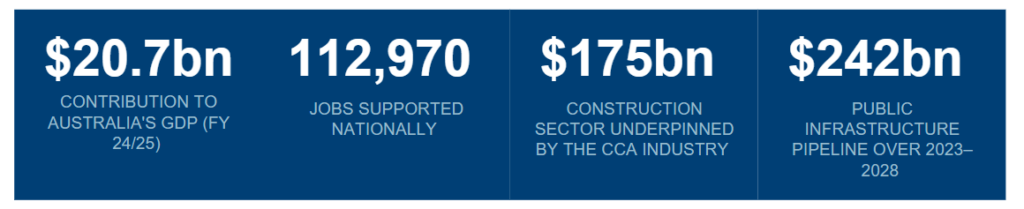
With Australia’s five-year public infrastructure pipeline valued at $242 billion, ambitious national housing targets of 1.2 million new homes by 2029, and the country’s accelerating energy transition placing rising demand on concrete-intensive materials, the need for a clear, evidence-based picture of the industry’s economic significance had never been more urgent.
The Challenge: Building an evidence base to inform policy, investment, and industry strategy
CCAA needed independent, rigorous analysis that would go beyond simple direct employment or revenue figures to capture the full cascade of economic activity its members generate. The key challenge was to demonstrate – credibly and comprehensively – how the CCA industry’s activities ripple through Australia’s economy: through supply chains involving mining, transport, manufacturing, and professional services; through the wages its workforce spends across every sector of the economy; and through its indispensable role enabling a $175 billion construction sector that itself accounts for 7.6% of Australia’s GDP.
The analysis needed to work at multiple levels simultaneously: national totals that would resonate with federal policymakers, state-level breakdowns that would speak to the priorities of each government and jurisdiction, and thematic deep-dives into the structural challenges – supply chain resilience, productivity, labour shortages, and the path to net zero by 2050 – that will determine whether the industry can meet Australia’s future demands.
Without a credible, independently produced evidence base of this scale and rigour, CCAA would struggle to secure the planning protections, approvals reforms, and policy support its members needed to deliver the materials underpinning Australia’s infrastructure ambitions.
Solution: Independent modelling and strategic analysis that quantified the industry’s true value – and gave CCAA the tools to act on it
Oxford Economics Australia designed and executed a comprehensive economic contribution assessment using an input-output model of the Australian economy, calibrated to ABS national accounts data and IBIS World industry figures. The modelling captured the industry’s total economic footprint across three channels – direct activity within the CCA industry itself, indirect effects through its supply chain, and induced impacts from employee spending – producing definitive national and state-level estimates for FY 2024/25.
National GDP & Employment Breakdown


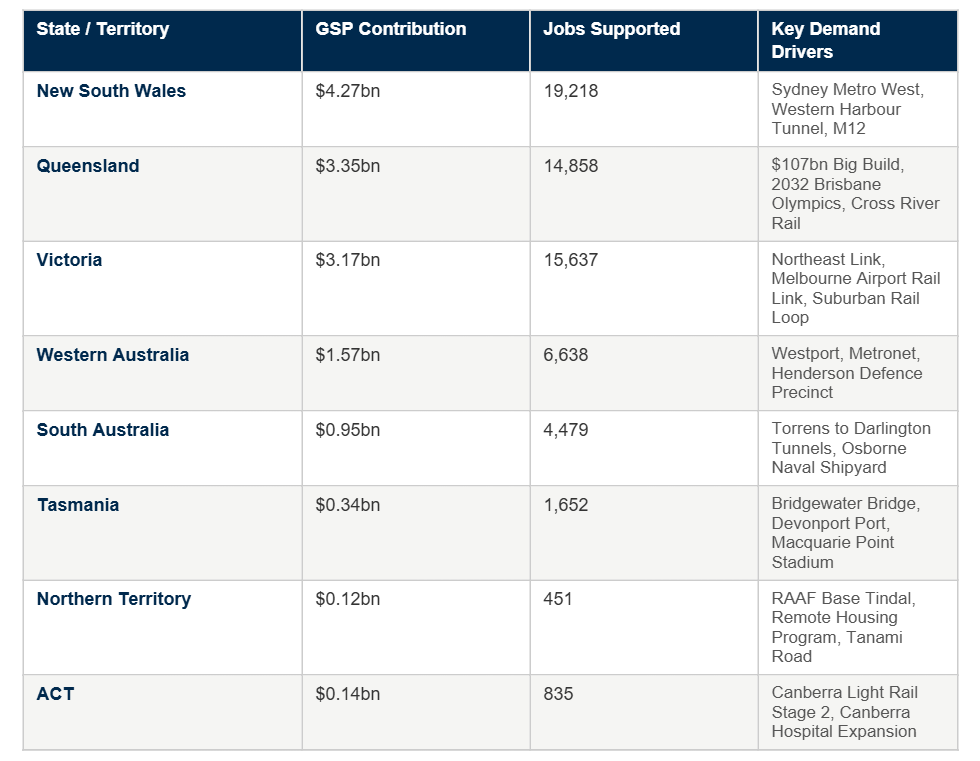
The state-level modelling delivered granular, jurisdiction-specific results that gave CCAA and its members direct leverage in discussions with each state and territory government.
State & Territory Contributions | FY 2024/25
Beyond the headline economic numbers, Oxford Economics delivered four thematic analyses that translated the data into actionable strategic intelligence:
- Supply chain analysis – mapping CCA’s economic linkages across 19 industry sectors, from mining and transport through to professional services and retail, demonstrating the breadth of its contribution and the systemic risk a supply disruption would pose.
- Productivity analysis – drawing on multi-factor productivity data from 1990 to 2024, placing the CCA industry’s performance in the context of upstream mining and downstream construction, and identifying where targeted improvements could generate the greatest returns.
- Supply chain resilience assessment – providing an independent evidence base for CCAA’s core policy asks: faster quarry approvals, protection of industrial land near urban growth corridors, and investment in freight infrastructure.
- Decarbonisation analysis – laying out the industry’s pathway to net zero by 2050, examining the role of supplementary cementitious materials, alternative fuels, carbon capture, and regulatory reform in achieving climate targets without compromising construction delivery.
The result was a multi-dimensional body of work – not merely a set of numbers, but a structured, authoritative narrative that CCAA and its members could deploy in boardrooms, government submissions, media, and community engagement. Oxford Economics Australia’s independence and analytical rigour ensured the findings carried the credibility required to shift how decision-makers view the CCA industry: not as a commodity sector, but as a sovereign economic capability that underpins Australia’s infrastructure, housing, and clean energy future.
The experts behind the research
-
 Michael Brennan
Director - Economic Impact
Michael Brennan is a Director at Oxford Economics, based in Australia, specialising in applied microeconomics, including cost-benefit analysis, program evaluation, business cases and economic impact assessment. He has extensive experience advising government and corporate clients across transport, energy, technology, defence and infrastructure sectors.
Before joining Oxford Economics, Michael held leadership roles at Accenture Strategy, AlphaBeta and Deloitte Access Economics, where he led major projects on the energy transition, digital transformation, infrastructure investment and workforce planning. His work has influenced public policy, government investment decisions and regulation across some of Australia’s most critical industries.
Michael holds a Bachelor of Economics (First Class Honours) and Bachelor of Commerce from the University of Western Australia.