


Recent events in the Gulf that have disrupted production and tied up key trade arteries like the Strait of Hormuz have sent oil prices soaring above US$100 per barrel for the first time in four years, fluctuating around multi-decade highs. Gas prices could be just as volatile, if not more, due to weaker buffers. This will be more painful for some. Swings in commodity prices will be acutely felt by economies heavily dependent on fossil fuel imports like Japan, South Korea, Taiwan, and the EU.
East Asia and Europe rely on fossil fuel imports to power their economies
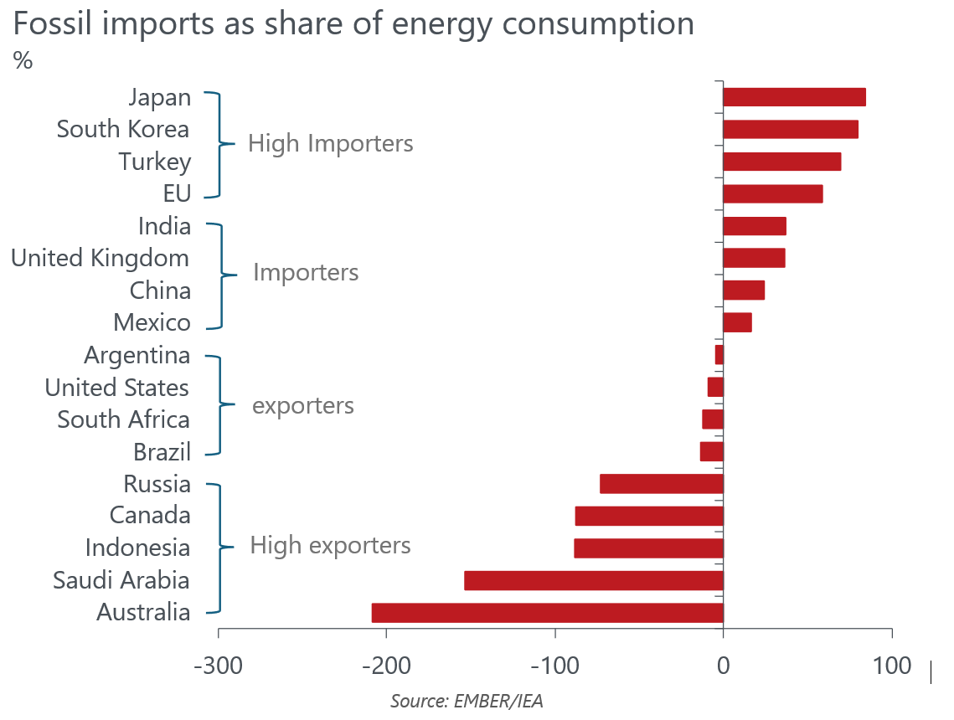
Japan and South Korea stand out as particularly exposed, importing more than 80% of the energy they consume. They have large energy-intensive industrial sectors but have limited domestic energy resources. It also doesn’t help that they are island nations and can’t easily import gas through pipelines. Fuel must be shipped. This war inflicts more pain because roughly 70% of Japan and Korea’s oil imports pass through the Strait of Hormuz. Along with the Strait of Malacca, the Strait of Hormuz functions as a shortcut. This path is faster and cheaper, more than one-third shorter than other alternatives. But, as this war unveils, this leaves both vulnerable to disruptions along these corridors. Expanding domestically produced renewable energy offers a potential path to an energy source that’s secure, sustainable, and less exposed to geopolitical supply shocks.
Renewables can act as a buffer from commodity price shocks
Generally, energy from renewables is insulated from commodity price shocks. Technologies such as solar and wind have no fuel input costs. Their economics are dominated by large upfront capital expenditure, followed by relatively small, fixed operating costs and minimal variable costs. It would be good to note that the construction of renewable generating assets is less protected from commodity price shocks (e.g., the price of metals), but it is more insulated once installed. After installation, the marginal cost of producing the next unit of electricity is close to zero. This cost structure shields renewable power generation from swings in fossil fuel markets. In contrast, most of the costs of oil and gas-fired plants come from the fuel it burns. These plants are directly exposed to market prices, which move sharply in response to geopolitical shocks. If we replace energy supply exposed to potentially volatile prices with one that’s stable, it becomes an effective hedge.
This hedge won’t break the bank like before. The costs of renewable energy have continued to fall, strengthening their economic viability. Today, the levelised cost of new renewable capacity now equals or undercuts new gas-fired generation in most major markets. Unlike gas plants, much of the cost is effectively locked in at the point of financing rather than remaining exposed to future fuel price movements. Plus, the direction of policy remains headed towards phasing out fossil fuels and reducing emissions, with many countries strengthening climate commitments. Renewables are better aligned with this long-term direction of energy markets and policy, making them the more future-proof choice. Just to cover our bases, realising the full benefits of renewables requires parallel investment in energy storage. Solar and wind energy are intermittent, and storage will help balance supply and demand across time.
Using South Korea as an example, we use the Oxford Economics’ Global Economic Model (GEM) to show that if countries were to increase their renewable capacity, especially when combined with higher electrification rates in other sectors such as road transport, it can soften the economic impact of fossil fuel price spikes.
The scenario results support our thesis, and you can download the brief for more information. But we must note that renewable energy is primarily a long-term solution. You can’t build a solar or wind farm overnight. This means other measures to reduce import reliance in the near term may be necessary. Countries that have already invested in low-carbon power are better placed to benefit today. Looking ahead, investment in renewables is no longer only about climate policy. It is also central to energy security and, in many cases, economic stability.
If you’d like to learn more about our full modelling and scenario analysis of how building renewable capacity can hedge against commodity price shocks, download our report.
You might also be interested in
Subscribe to our climate newsletter
Unlock exclusive economic and business insights — sign up for our newsletter today.
Subscribe