

RESEARCH BRIEFING
19 Mar 2026
The Iran war strengthens the case for renewables in energy security
Renewable energy offers a hedge against unpredictable fossil fuel prices
Building out renewable capacity can hedge against commodity price shocks, as we show with scenario analysis using Oxford Economics’ Global Economic Model (GEM).
Recent events in the Gulf highlight why this matters:
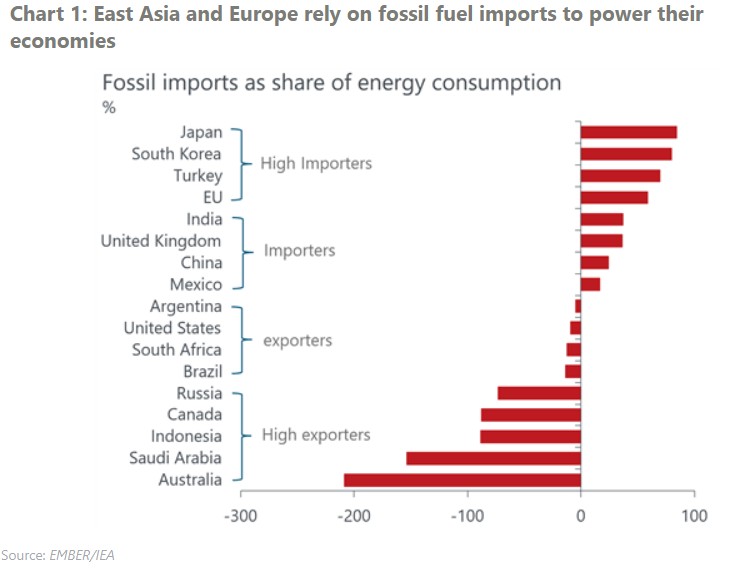
- Geopolitical shocks affecting large oil and gas producers increase fossil fuel prices and their volatility, but countries’ exposure to such shocks varies. Fossil fuel-import-dependent economies such as Japan and South Korea are exposed to shocks given their heavy reliance on energy supplies from the Middle East. Developing their own home-grown source of energy should help.
- Since solar and wind technology do not require fossil fuel inputs, their generation costs are less tied to volatile global energy markets.
- Our scenario uses South Korea as an example and shows that the current pass-through of a 50% rise in oil and gas prices declines as renewable capacity increases. The pass-through is lowest – and hence the hedge is strongest – when electrification also rises and renewables are deployed at scale.
- Ultimately, scaling renewables proves to be sound energy and macroeconomic policy.
You might also be interested in
Tags: