
A leading property investment company The ever-changing economic landscape means that effective strategic planning has never been more important. In 2019, a prestigious property investment and management company engaged Oxford Economics’ Boardroom and Executive Briefing Service to support its annual strategic planning process. Download Now Overview Once a year, our client reviews its 10-year strategic … Read more

Research Briefing | Jan 28, 2022

Global real estate to outperform bonds and equities
Global | Real estate to outperform bonds and equities

Global real estate returns are looking healthy over the next five years, providing a strong relative performance versus bonds and equities. We forecast total returns for global direct real estate and REITs to average 6.5% to 7% annually over 2022-2026, significantly above bonds and equities, which are projected to return 0.7% and 2.5% per annum, respectively.

Read more

Research Briefing | Jan 28, 2022

Global real estate to outperform bonds and equities

Global | Real estate to outperform bonds and equities

Global real estate returns are looking healthy over the next five years, providing a strong relative performance versus bonds and equities. We forecast total returns for global direct real estate and REITs to average 6.5% to 7% annually over 2022-2026, significantly above bonds and equities, which are projected to return 0.7% and 2.5% per annum, respectively.

Read more

North America housing
Research Briefing | Jan 21, 2022

US and Canada housing affordability edged down in Q3

US and Canada housing affordability edged down in Q3 - iPad

Our updated Housing Affordability Indices (HAIs) show affordability declined in Q3 2021 at the national level in the US and Canada as income gains and slightly lower mortgage rates weren’t enough to keep up with house prices. Potential buyers found homes remained most out of reach in Vancouver, Boise (Idaho), Portland (Oregon), Toronto, Las Vegas, San Jose, L.A., and Hamilton (Ontario).

What you will learn:

  • Our national US index rose 1pt to 0.78 in Q3 2021 from 0.77 in Q2, meaning prices were 22% lower than the median income households’ borrowing capacity.
  • US affordability in Q3 2021 deteriorated most sharply in the Sunbelt metros, led by Tampa (+6.9pts), Las Vegas (+5.9pts), and Austin (+5.7pts).
  • Our Canada-wide HAI rose 1pt to 1.36 in Q3 2021, meaning houses were 36% above median income households’ borrowing capacity.

Read more

Research Briefing | Jan 21, 2022

US and Canada housing affordability edged down in Q3

US and Canada housing affordability edged down in Q3 - iPad

Our updated Housing Affordability Indices (HAIs) show affordability declined in Q3 2021 at the national level in the US and Canada as income gains and slightly lower mortgage rates weren’t enough to keep up with house prices. Potential buyers found homes remained most out of reach in Vancouver, Boise (Idaho), Portland (Oregon), Toronto, Las Vegas, San Jose, L.A., and Hamilton (Ontario).

What you will learn:

  • Our national US index rose 1pt to 0.78 in Q3 2021 from 0.77 in Q2, meaning prices were 22% lower than the median income households’ borrowing capacity.
  • US affordability in Q3 2021 deteriorated most sharply in the Sunbelt metros, led by Tampa (+6.9pts), Las Vegas (+5.9pts), and Austin (+5.7pts).
  • Our Canada-wide HAI rose 1pt to 1.36 in Q3 2021, meaning houses were 36% above median income households’ borrowing capacity.

Read more

Nordics real estate
Research Briefing | Jan 19, 2022

European real estate obsolescence risk lowest for the Nordics

Ipad Frame - Europe-Real-estate-obsolescence-risk-lowest-for-the-Nordics

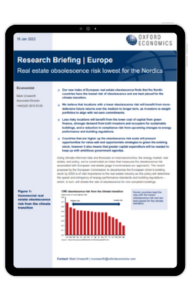
Our new index of European real estate obsolescence finds that the Nordic countries have the lowest risk of obsolescence and are best placed for the climate transition.

Read more

Research Briefing | Jan 19, 2022

European real estate obsolescence risk lowest for the Nordics

Ipad Frame - Europe-Real-estate-obsolescence-risk-lowest-for-the-Nordics

Our new index of European real estate obsolescence finds that the Nordic countries have the lowest risk of obsolescence and are best placed for the climate transition.

Read more

Research Briefing | Jan 17, 2022

US retail real estate pricing rebound looks unlikely

US retail real estate pricing rebound looks unlikely cover

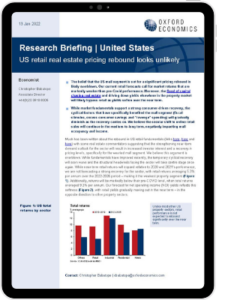
Much has been written about the rebound in US retail fundamentals with some real estate commentators suggesting that the strengthening near-term demand outlook for the sector will result in increased investor interest and a recovery in pricing levels, specifically for the wearied mall segment. We believe this argument is overblown.

What you will learn:

  • Our current retail forecasts call for market returns that are markedly weaker than pre-Covid performance.
  • The flood of capital chasing real estate and driving down yields elsewhere in the property market will likely bypass retail as yields soften over the near term.
  • While fundamentals have improved recently, the temporary cyclical recovery will soon wane and the structural headwinds facing the sector will take centre stage once again.

Read more

Research Briefing | Jan 17, 2022

US retail real estate pricing rebound looks unlikely

US retail real estate pricing rebound looks unlikely cover

Much has been written about the rebound in US retail fundamentals with some real estate commentators suggesting that the strengthening near-term demand outlook for the sector will result in increased investor interest and a recovery in pricing levels, specifically for the wearied mall segment. We believe this argument is overblown.

What you will learn:

  • Our current retail forecasts call for market returns that are markedly weaker than pre-Covid performance.
  • The flood of capital chasing real estate and driving down yields elsewhere in the property market will likely bypass retail as yields soften over the near term.
  • While fundamentals have improved recently, the temporary cyclical recovery will soon wane and the structural headwinds facing the sector will take centre stage once again.

Read more

residential real estate
News|11 January 2022

Introducing Oxford Economics’ new Real Estate Economics Service

Introducing Oxford Economics’ new Real Estate Economics Service

Oxford Economics is proud to announce the launch of its new Real Estate Economics Service. The service helps companies understand the implications of macroeconomic, geopolitical, financial and climate change developments on private and public real estate performance. It is the first globally consistent and independent set of real estate forecasts, the service offers regular analysis and commentary from our highly experienced team of real estate economists.

Read more

Wall Street
Research Briefing | Dec 21, 2021

United States recoveries in 2022 are inversely proportionate to 2020 declines

United States | Recoveries in 2022 are inversely proportionate to 2020 declines

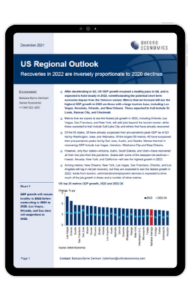
After decelerating in Q3, US GDP growth resumed a healthy pace in Q4, and is expected to hold steady in 2022, notwithstanding the potential short term economic impact from the Omicron variant. Metros that we forecast will see the highest GDP growth in 2022 are those with a large tourism base, including Las Vegas, Honolulu, Orlando, and New Orleans. Those expected to trail include St. Louis, Kansas City, and Cincinnati.

Read more

Research Briefing | Dec 21, 2021

United States recoveries in 2022 are inversely proportionate to 2020 declines

United States | Recoveries in 2022 are inversely proportionate to 2020 declines

After decelerating in Q3, US GDP growth resumed a healthy pace in Q4, and is expected to hold steady in 2022, notwithstanding the potential short term economic impact from the Omicron variant. Metros that we forecast will see the highest GDP growth in 2022 are those with a large tourism base, including Las Vegas, Honolulu, Orlando, and New Orleans. Those expected to trail include St. Louis, Kansas City, and Cincinnati.

Read more

Research Briefing

The global real estate rebound is under threat

Ipad Frame - The-global-real-estate-rebound-is-under-threat

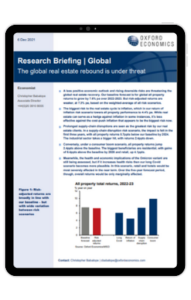
A less positive economic outlook and rising downside risks are threatening the global real estate recovery. Our baseline forecast is for global all property returns to grow by 7.6% pa over 2022-2023. But risk-adjusted returns are weaker, at 7.3% pa, based on the weighted-average of all risk scenarios.

Read more

Research Briefing

The global real estate rebound is under threat

Ipad Frame - The-global-real-estate-rebound-is-under-threat

A less positive economic outlook and rising downside risks are threatening the global real estate recovery. Our baseline forecast is for global all property returns to grow by 7.6% pa over 2022-2023. But risk-adjusted returns are weaker, at 7.3% pa, based on the weighted-average of all risk scenarios.

Read more

the 12 apostles at sunset
Research Briefing | Dec 1, 2021

Credit conditions still favourable but on the move

Copy of Ipad Frame (6)

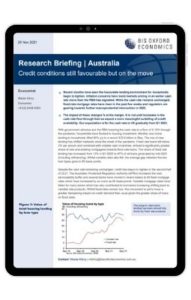
Recent months have seen the favourable lending environment for households begin to tighten. Inflation concerns have bond markets pricing in an earlier cash rate move than the RBA has signalled. While the cash rate remains unchanged, fixed rate mortgage rates have risen in the past few weeks and regulators are gearing towards further macroprudential intervention in 2022.

The impact of these changes is at the margin. It is not until increases in the cash rate flow through that we expect a more meaningful curtailing of credit availability. Our expectation is for the cash rate to lift gradually from Q1 2023.

Read more

Research Briefing | Dec 1, 2021

Credit conditions still favourable but on the move

Copy of Ipad Frame (6)

Recent months have seen the favourable lending environment for households begin to tighten. Inflation concerns have bond markets pricing in an earlier cash rate move than the RBA has signalled. While the cash rate remains unchanged, fixed rate mortgage rates have risen in the past few weeks and regulators are gearing towards further macroprudential intervention in 2022.

The impact of these changes is at the margin. It is not until increases in the cash rate flow through that we expect a more meaningful curtailing of credit availability. Our expectation is for the cash rate to lift gradually from Q1 2023.

Read more

Podcast|22 November 2021

Australian Apartment Advocacy: 2021 Investor Insights

Australian Apartment Advocacy: 2021 Investor Insights

BIS Oxford Economics and Australian Apartment Advocacy delve into the apartment investment sector and just what can be expected for 2021 and beyond.

Maree Kilroy and Timothy Hibbert of BIS Oxford Economics provide a detailed forecast on apartment construction, prices, rents and any opportunities/risks for the sector looking forward.

Samantha Reece of AAA the outlines the organisations recent research with 1000 investors nationwide (completed May 2021) as to their optimism level with their apartment values, their preparedness to invest in apartments again and what the market will be looking out for.

Read more

Research Briefing | Oct 20, 2021

US | Metro Economic Forecast: San Francisco

Metro Economic Forecast San Francisco September 2021 - iPad

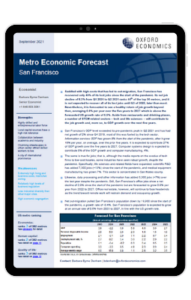
Saddled with high costs that has led to out-migration, San Francisco has recovered only 40% of its lost jobs since the start of the pandemic. Its net job decline of 8.3% from Q1 2020 to Q2 2021 ranks 46th of the top 50 metros, and it is not expected to recover all of its lost jobs until Q3 of 2022, later than most. Nevertheless, it is forecasted to see a healthy return of job growth beyond then, averaging 0.8% per year over the five years to 2027 which is above the forecasted US growth rate of 0.5%. Aside from restaurants and drinking places, a number of STEM-related sectors – tech and life sciences — will contribute to the job growth and, more so, to GDP growth over the next five years.

Read more

Research Briefing | Oct 20, 2021

US | Metro Economic Forecast: San Francisco

Metro Economic Forecast San Francisco September 2021 - iPad

Saddled with high costs that has led to out-migration, San Francisco has recovered only 40% of its lost jobs since the start of the pandemic. Its net job decline of 8.3% from Q1 2020 to Q2 2021 ranks 46th of the top 50 metros, and it is not expected to recover all of its lost jobs until Q3 of 2022, later than most. Nevertheless, it is forecasted to see a healthy return of job growth beyond then, averaging 0.8% per year over the five years to 2027 which is above the forecasted US growth rate of 0.5%. Aside from restaurants and drinking places, a number of STEM-related sectors – tech and life sciences — will contribute to the job growth and, more so, to GDP growth over the next five years.

Read more

Toronto
Research Briefing | Oct 19, 2021

Edmonton leads 2021 rebound, Toronto’s growth more moderate

Canadian Regional Outlook Q3 2021 - iPad

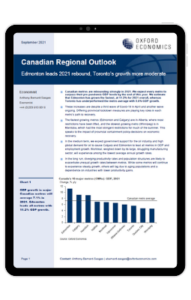
Canadian metros are rebounding strongly in 2021. We expect every metro to surpass their pre-pandemic GDP levels by the end of this year. We estimate that Edmonton has grown the fastest, at 11.2% for 2021 overall, whereas Toronto has underperformed the metro average with 5.6% GDP growth.

Read more

Research Briefing | Oct 19, 2021

Edmonton leads 2021 rebound, Toronto’s growth more moderate

Canadian Regional Outlook Q3 2021 - iPad

Canadian metros are rebounding strongly in 2021. We expect every metro to surpass their pre-pandemic GDP levels by the end of this year. We estimate that Edmonton has grown the fastest, at 11.2% for 2021 overall, whereas Toronto has underperformed the metro average with 5.6% GDP growth.

Read more

Canadian money
Research Briefing | Oct 19, 2021

North America Housing affordability fell in Q2 and is likely to worsen

Housing affordability fell in Q2 and is likely to worsen - iPad

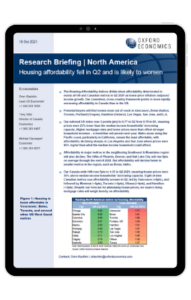
The Housing Affordability Indices (HAIs) show affordability deteriorated in nearly all US and Canadian metros in Q2 2021 as home price inflation outpaced income growth. Our consistent, cross-country framework points to more rapidly worsening affordability in Canada than in the US.

What you will learn:

  • Potential buyers will find homes most out of reach in Vancouver, Boise (Idaho), Toronto, Portland (Oregon), Hamilton (Ontario), Las Vegas, San Jose, and L.A.
  • Our national US index rose 3 points (pts) to 0.77 in Q2 from 0.74 in Q1, meaning prices were 23% lower than the median income households’ borrowing capacity. Higher mortgage rates and home prices more than offset stronger household incomes – a trend that will persist next year. 
  • Affordability in major metros in the neighboring Southwest & Mountains region will also decline. The HAIs of Phoenix, Denver, and Salt Lake City will rise 6pts on average through the end of 2022.

Read more

Research Briefing | Oct 19, 2021

North America Housing affordability fell in Q2 and is likely to worsen

Housing affordability fell in Q2 and is likely to worsen - iPad

The Housing Affordability Indices (HAIs) show affordability deteriorated in nearly all US and Canadian metros in Q2 2021 as home price inflation outpaced income growth. Our consistent, cross-country framework points to more rapidly worsening affordability in Canada than in the US.

What you will learn:

  • Potential buyers will find homes most out of reach in Vancouver, Boise (Idaho), Toronto, Portland (Oregon), Hamilton (Ontario), Las Vegas, San Jose, and L.A.
  • Our national US index rose 3 points (pts) to 0.77 in Q2 from 0.74 in Q1, meaning prices were 23% lower than the median income households’ borrowing capacity. Higher mortgage rates and home prices more than offset stronger household incomes – a trend that will persist next year. 
  • Affordability in major metros in the neighboring Southwest & Mountains region will also decline. The HAIs of Phoenix, Denver, and Salt Lake City will rise 6pts on average through the end of 2022.

Read more

Research Briefing | Oct 13, 2021

US | Metro Economic Forecast: New York

Metro Economic Forecast New York September 2021 - iPad

Still lagging its peers, New York has recovered only 49% of its lost jobs since the start of the pandemic. Its net job decline of 9.1% from Q1 2020 to Q2 2021 ranks 47th of the top 50 metros. New York is expected to recover all of its lost jobs in Q3 of 2023, later than most. New York is expected to see average annual job growth of 0.5% over the five years to 2027, on par with the expected US job growth rate. Industries expected to contribute to the growth include restaurants and drinking places with 23.4% of the total jobs followed by home health care with 20.6% and education with 14.2%. The finance sector is expected to recover in 2022 but then remain flat through 2025.

Read more

Research Briefing | Oct 13, 2021

US | Metro Economic Forecast: New York

Metro Economic Forecast New York September 2021 - iPad

Still lagging its peers, New York has recovered only 49% of its lost jobs since the start of the pandemic. Its net job decline of 9.1% from Q1 2020 to Q2 2021 ranks 47th of the top 50 metros. New York is expected to recover all of its lost jobs in Q3 of 2023, later than most. New York is expected to see average annual job growth of 0.5% over the five years to 2027, on par with the expected US job growth rate. Industries expected to contribute to the growth include restaurants and drinking places with 23.4% of the total jobs followed by home health care with 20.6% and education with 14.2%. The finance sector is expected to recover in 2022 but then remain flat through 2025.

Read more

Research Briefing | Oct 13, 2021

US | Recovery patterns reflect tourism and office-based sector exposure

Ipad Frame-US-Recovery-patterns-reflect-tourism-and-office-based-sector-exposure

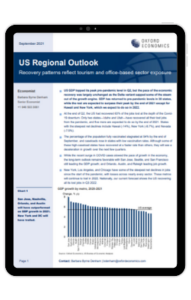
US GDP topped its peak pre-pandemic level in Q2, but the pace of the economic recovery was largely unchanged as the Delta variant sapped some of the steam out of the growth engine. GDP has returned to pre-pandemic levels in 38 states, while the rest are expected to surpass their peak by the end of 2021 except for Hawaii and New York, which we expect to do so in 2022.

Read more

Research Briefing | Oct 13, 2021

US | Recovery patterns reflect tourism and office-based sector exposure

Ipad Frame-US-Recovery-patterns-reflect-tourism-and-office-based-sector-exposure

US GDP topped its peak pre-pandemic level in Q2, but the pace of the economic recovery was largely unchanged as the Delta variant sapped some of the steam out of the growth engine. GDP has returned to pre-pandemic levels in 38 states, while the rest are expected to surpass their peak by the end of 2021 except for Hawaii and New York, which we expect to do so in 2022.

Read more

Research Briefing | Oct 13, 2021

US | Metro Economic Forecast: Los Angeles

Research brifing for us city forecast losangeles

Los Angeles, like New York, has suffered from urban flight that has persisted due to the delta variant. LA has recovered only 44% of its lost jobs since the start of the pandemic, and its net job decline of 8% ranks 45th of the largest 50 metros. Los Angeles is expected to recover all of its lost jobs in Q1 of 2023. Some industries have seen some growth since the start of the pandemic including couriers and express delivery services which has grown 33.9%, and scientific R&D (+4.2%). LA is expected to see average annual job growth of 0.5% over the five years to 2027, in line with the US average. Industries expected to contribute to growth include social services with 34% of the total jobs, restaurants and drinking places, and arts and entertainment.

Read more

Research Briefing | Oct 13, 2021

US | Metro Economic Forecast: Los Angeles

Research brifing for us city forecast losangeles

Los Angeles, like New York, has suffered from urban flight that has persisted due to the delta variant. LA has recovered only 44% of its lost jobs since the start of the pandemic, and its net job decline of 8% ranks 45th of the largest 50 metros. Los Angeles is expected to recover all of its lost jobs in Q1 of 2023. Some industries have seen some growth since the start of the pandemic including couriers and express delivery services which has grown 33.9%, and scientific R&D (+4.2%). LA is expected to see average annual job growth of 0.5% over the five years to 2027, in line with the US average. Industries expected to contribute to growth include social services with 34% of the total jobs, restaurants and drinking places, and arts and entertainment.

Read more

Research Briefing | Aug 5, 2021

US | Metro Economic Forecast: Philadelphia

Metro Economic Forecast Philadelphia June 2021 - iPad

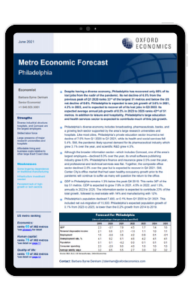
Despite having a diverse economy, Philadelphia has recovered only 55% of its lost jobs from the nadir of the pandemic. Its net decline of 6.5% from the previous peak of Q1 2020 ranks 33rd of the largest 51 metros and below the US net decline of 5.6%. Philadelphia is expected to see job growth of 3.6% in 2021, 4.2% in 2022, and is expected to recover all of its lost jobs in Q3 2022. Its expected average annual job growth of 0.3% in 2023 to 2025 ranks 42nd of 51 metros. In addition to leisure and hospitality, Philadelphia’s large education and health services sector is expected to contribute much of this job growth.

Read more

Research Briefing | Aug 5, 2021

US | Metro Economic Forecast: Philadelphia

Metro Economic Forecast Philadelphia June 2021 - iPad

Despite having a diverse economy, Philadelphia has recovered only 55% of its lost jobs from the nadir of the pandemic. Its net decline of 6.5% from the previous peak of Q1 2020 ranks 33rd of the largest 51 metros and below the US net decline of 5.6%. Philadelphia is expected to see job growth of 3.6% in 2021, 4.2% in 2022, and is expected to recover all of its lost jobs in Q3 2022. Its expected average annual job growth of 0.3% in 2023 to 2025 ranks 42nd of 51 metros. In addition to leisure and hospitality, Philadelphia’s large education and health services sector is expected to contribute much of this job growth.

Read more

Research Briefing | Aug 5, 2021

US | Metro Economic Forecast: Atlanta

Metro Economic Forecast Atlanta June 2021 - iPad

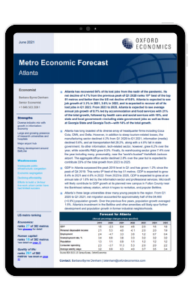
Atlanta has recovered 56% of its lost jobs from the nadir of the pandemic. Its net decline of 4.7% from the previous peak of Q1 2020 ranks 19th best of the top 51 metros and better than the US net decline of 5.6%. Atlanta is expected to see job growth of 3.3% in 2021, 3.6% in 2022, and is expected to recover all of its lost jobs in Q1 2022. From 2023 to 2025, Atlanta is expected to see average annual job growth of 0.7% led by accommodation and food services with 21% of the total growth, followed by health care and social services with 15%, and state and local government—including state government jobs as well as those at Georgia State and Georgia Tech—with 14% of the total growth.

Read more

Research Briefing | Aug 5, 2021

US | Metro Economic Forecast: Atlanta

Metro Economic Forecast Atlanta June 2021 - iPad

Atlanta has recovered 56% of its lost jobs from the nadir of the pandemic. Its net decline of 4.7% from the previous peak of Q1 2020 ranks 19th best of the top 51 metros and better than the US net decline of 5.6%. Atlanta is expected to see job growth of 3.3% in 2021, 3.6% in 2022, and is expected to recover all of its lost jobs in Q1 2022. From 2023 to 2025, Atlanta is expected to see average annual job growth of 0.7% led by accommodation and food services with 21% of the total growth, followed by health care and social services with 15%, and state and local government—including state government jobs as well as those at Georgia State and Georgia Tech—with 14% of the total growth.

Read more

Research Briefing | Jul 30, 2021

US | Metro Economic Forecast: Columbus

Metro Economic Forecast Columbus June 2021 - iPad

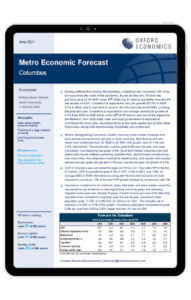
Having suffered less during the pandemic, Columbus has recovered 70% of its lost jobs from the nadir of the pandemic. Its net decline of 3.1% from the previous peak of Q1 2020 ranks 10th of the top 51 metros and better than the US net decline of 5.6%. Columbus is expected to see job growth of 3.3% in 2021, 2.7% in 2022, and is expected to recover all of its lost jobs in Q4 2021. Looking beyond next year, Columbus is expected to see average annual job growth of 0.6% from 2023 to 2025 which ranks 28th of 51 metros and one of the highest in the Midwest. Over 2023-2025, state and local government is expected to contribute the most jobs—including those at the state capital and at Ohio State University—along with warehousing, hospitality and restaurants.

Read more

Research Briefing | Jul 30, 2021

US | Metro Economic Forecast: Columbus

Metro Economic Forecast Columbus June 2021 - iPad

Having suffered less during the pandemic, Columbus has recovered 70% of its lost jobs from the nadir of the pandemic. Its net decline of 3.1% from the previous peak of Q1 2020 ranks 10th of the top 51 metros and better than the US net decline of 5.6%. Columbus is expected to see job growth of 3.3% in 2021, 2.7% in 2022, and is expected to recover all of its lost jobs in Q4 2021. Looking beyond next year, Columbus is expected to see average annual job growth of 0.6% from 2023 to 2025 which ranks 28th of 51 metros and one of the highest in the Midwest. Over 2023-2025, state and local government is expected to contribute the most jobs—including those at the state capital and at Ohio State University—along with warehousing, hospitality and restaurants.

Read more

Research Briefing | Jul 30, 2021

US | Metro Economic Forecast: San Francisco

Metro Economic Forecast San Francisco June 2021 - iPad

Struggling to recover from the reported exodus of residents during the pandemic, San Francisco has recouped only 28% of its lost jobs from the nadir of the outbreak. This corresponds to a net decline of 10% from the previous peak of Q1 2020 which ranks 46th of the largest 51 metros. San Francisco is expected to see job growth of 2.5% in 2021 but then jump 7.5% in 2022. It is expected to recover all of its lost jobs in Q3 2022.

Read more

Research Briefing | Jul 30, 2021

US | Metro Economic Forecast: San Francisco

Metro Economic Forecast San Francisco June 2021 - iPad

Struggling to recover from the reported exodus of residents during the pandemic, San Francisco has recouped only 28% of its lost jobs from the nadir of the outbreak. This corresponds to a net decline of 10% from the previous peak of Q1 2020 which ranks 46th of the largest 51 metros. San Francisco is expected to see job growth of 2.5% in 2021 but then jump 7.5% in 2022. It is expected to recover all of its lost jobs in Q3 2022.

Read more