

Why Easter eggs are still expensive in 2026 – and could get worse

Easter is around the corner, and for many of us with a sweet tooth, that means one thing: chocolate! But if you’ve noticed that Easter eggs are getting smaller and more expensive, you’re not alone.
So why are Easter eggs so expensive, and will prices fall anytime soon?
Global cocoa prices have pushed up Easter egg prices
The answer to the first question can be found in the dynamics of the cocoa market. Prices for cocoa, a key ingredient for chocolate, have been especially volatile over the past few years. Back in early 2024, disease, poor weather, and ageing trees that had not been replaced hit cocoa production in Cote d’Ivoire and Ghana. These two countries account for around 60% of world production, and the supply shortfall pushed the global cocoa market into its largest deficit in over 60 years, sending cocoa prices to record highs.
The issue with cocoa production is that supply doesn’t respond quickly to price signals. This is firstly because it takes at least three years after planting for cocoa trees to begin flowering and producing cocoa pods. Secondly, cocoa farmers receive a centrally set farmgate price that insulates them from international commodity price volatility, but at the same time, dulls the price signals that would typically encourage more planting.
As a result of the slow supply response, demand drove most of the price correction. Chocolate manufacturers lowered their cocoa usage by substituting more milk and sugar, which is why Easter eggs were lighter in colour last year. Favourable weather helped on the supply side, and expanding production in South America provided additional cocoa to the market, easing some of the pressure on global supply. As market conditions gradually loosened, cocoa prices fell from their peaks in early 2025.
The impact of higher cocoa prices on Easter eggs of was clear. In 2025, retail prices for Easter eggs shot up, and were particularly pronounced due to the lagged effect of raw material costs feeding through.
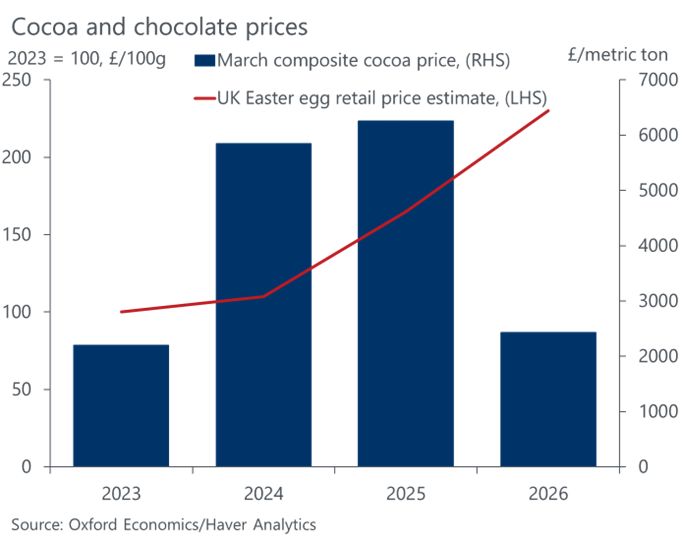
But Easter egg prices have been slow to respond to falling cocoa prices
Fast forward to this year, and despite the fall in cocoa prices, retail prices remain elevated for a few reasons. One is timing – manufacturers bought their cocoa months in advance at prices higher than current market rates and so must sell their chocolate at a higher price as well. They have also deployed ‘shrinkflation’, making products smaller to maintain sales while managing costs. Finally, retails prices are ‘sticky’: higher costs are passed on to consumers quickly, but lower costs are not. Consumer demand for chocolate also tends to be less responsive to price during seasonal peaks, such as Easter, allowing manufacturers to pass on higher input costs with greater confidence.
And the Iran war could mean even higher Easter egg prices next year
So, now that cocoa prices are coming down, can we look forward to cheaper Easter eggs in the years ahead as cocoa supply gets a chance to adjust? Unfortunately, not. This time, it’s a headwind affecting the agriculture sector as a whole, and retail Easter egg prices are likely to rise again next year.
The conflict in Iran has meant that around a third of global fertiliser supply is stuck behind the Strait of Hormuz. Restrictions on gas supply, a major input for fertiliser production, from the region have also meant fertiliser production elsewhere has been hit, resulting in surging fertiliser prices. If we assume that the Strait remains effectively closed to traffic until the end of May, West African farmers will be facing astronomical fertiliser prices or may even struggle to source it, just as they approach the most critical time in the calendar for fertiliser application. Higher prices and supply issues would mean lower fertiliser application than otherwise, especially given many farmers are smallholders with limited liquidity.
All in all, this would curb cocoa production and once again push up cocoa prices. If this were to happen, we could see even smaller Easter eggs and a return to greater substitution this time next year.
The cost of Easter chocolate is not just set in West African fields, but increasingly, in the shipping lanes of the Gulf, where supply disruptions continue to put pressure on input prices worldwide.
Behind the price of chocolate lies a much bigger story.
From cocoa and fertiliser to energy and geopolitics, commodity markets are shaped by interconnected global forces.
Our Global Commodity Service brings these together, combining macro insight, price forecasts, and expert analysis to help you navigate volatility with confidence.
You might also be interested in
Subscribe to our newsletters
Sign up to our newsletter to download the latest and most popular reports.
SubscribeAccess our latest commodity forecasts and market insights. Request a trial today.
Unlock exclusive economic and business insights—sign up for our newsletter today
Subscribe