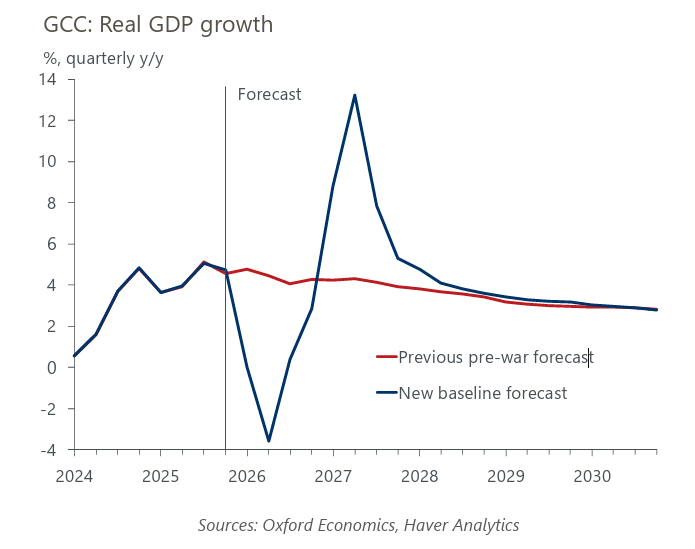

Iran war set to push GCC economies into recession
We expect the Gulf Cooperation Council (GCC) economies to enter recession in the first half of this year as the US-Israel war with Iran extends into its second month. We’ve updated our forecasts to reflect this and the risk of a prolonged conflict.
We’ve downgraded aggregate GCC real GDP growth for 2026 by 4.6ppts from our pre-war view to -0.2%, reflecting reduced oil production, exports, tourism, and domestic demand.
Qatar, Kuwait, Bahrain, and the UAE face significant downgrades due to their inability to reroute their hydrocarbon exports, which means production will need to shut down once storage facilities fill up. By contrast, we’ve given Oman and Saudi Arabia smaller downgrades, since they are less reliant on the Strait of Hormuz and can therefore maintain healthy export levels.
We forecast that the negative impact on tourism, along with domestic demand, will last much longer than the conflict and that the sector will take time to recover. The recovery depends on the level of security the GCC achieves once the war ends.
Some countries’ public finances will improve significantly, but only those that are able to export oil while prices remain high. We think the rest will see deterioration in their fiscal balances in the coming years.
Strikes on Qatar’s LNG infrastructure in Ras Laffan on March 18 damaged 17%-20% of the Qatar’s production capacity. Restoration will take an estimated three-to-five years, costing Qatar $20bn in lost revenue annually. Since the attack happened after we finalised our most recent forecasts, we’ll likely downgrade Qatar further in our April baseline.
Our latest update saw further downgrades across the region – GCC economies face recession